AI brand guidelines - for ChatGPT, Claude and Copilot
AI-ready brand guidelines: what they are and what goes in them
Your team asks ChatGPT for a LinkedIn post. It comes back with a promise nobody approved. The brand guidelines that could have stopped it are a PDF the tool has never opened.
 Vedran ObradovićFounder & Branding Specialist - - 8 min
AI-ready brand guidelines fix that. They are brand guidelines written so ChatGPT and Claude can follow them: the facts the AI may use, the promises it must never make, your voice shown in examples, and a check before anything ships. A PDF built for designers is not enough, because the tools your team writes with never open it.
Why do normal brand guidelines fail with AI?
Because they were written for a different reader. A designer opens the PDF, finds the hex code and the clear-space rule, and gets on with it. ChatGPT, Claude and Copilot do not open anything. They answer from what they were trained on, from what is pasted into the chat, and, with search on, from what they find online about you.
When the model knows little about your company, it fills the gap with a confident guess. That is where "99.9% uptime guarantee" comes from. It sounds like something a network company would say, so the model says it.
Here is the real case. I tested the same AI on Deepsea Networks, an offshore telecom company, with and without its brand system. With only a one-line prompt, 8 of 16 answers broke a hard rule: an invented fact, a leaked secret, a promise made for headquarters. One of them was a "99.9% uptime guarantee" nobody had approved. One line like that, sent to an operator, can cost a contract. The full test is in the proof section.
How are AI-ready guidelines different from a brand book?
| Brand book (PDF) | AI-ready guidelines | |
|---|---|---|
| Reader | Designers, printers, agencies | The people on your team and the AI tools they write with |
| Answers | What does the logo look like? | What may I say about the product? What must I never promise? How does the brand sound? |
| Format | One long PDF | Short plain-text files an AI can read, plus a place your team opens |
| Facts | Rarely included | A register: every claim, its source and its status |
| Rules | "Be friendly and professional" | Sentences a person or a tool can check a draft against |
| Updates | Every few years, if ever | Whenever a product, price or customer changes |
| Check before shipping | None | A short list every draft passes |
I build both. They do different jobs, and one cannot replace the other.
What goes in AI-ready brand guidelines?
Six parts. Each one is something you can paste, check or open. Nothing that lives only in a slide.
Step 1: A facts register
A list of every claim the company makes, with a status. Approved, needs a check, never use. If a number is not in the register, the AI is told to leave a visible placeholder instead of guessing.
Example (an invented company, "Northwind Cloud"):
| Fact | Status | Source |
|---|---|---|
| 140 customers in 12 countries | Approved | CRM export, 1 October |
| Support replies within 4 hours on business days | Approved | Support policy v3 |
| EU data centre in Frankfurt | Approved | Contract template |
| Uptime guarantee of any percentage | Never use | Legal has not approved one |
I made a free facts register template for this, in English and Croatian. It goes live in week 3.
Step 2: Never-promise rules
Guarantees, unreleased features, comparisons with competitors, claims about customers. Write them as sentences a tool can check:
- Never state an uptime, refund or delivery guarantee. If a draft needs one, write [FACT NEEDED] and stop.
- Never describe a feature as live if it is marked "roadmap" in the register.
- Never name a competitor.
Step 3: Voice in examples
"Friendly and professional" tells an AI nothing. Two lines do: one in your voice, one in the voice you do not want. Add the words you use and the words you never use.
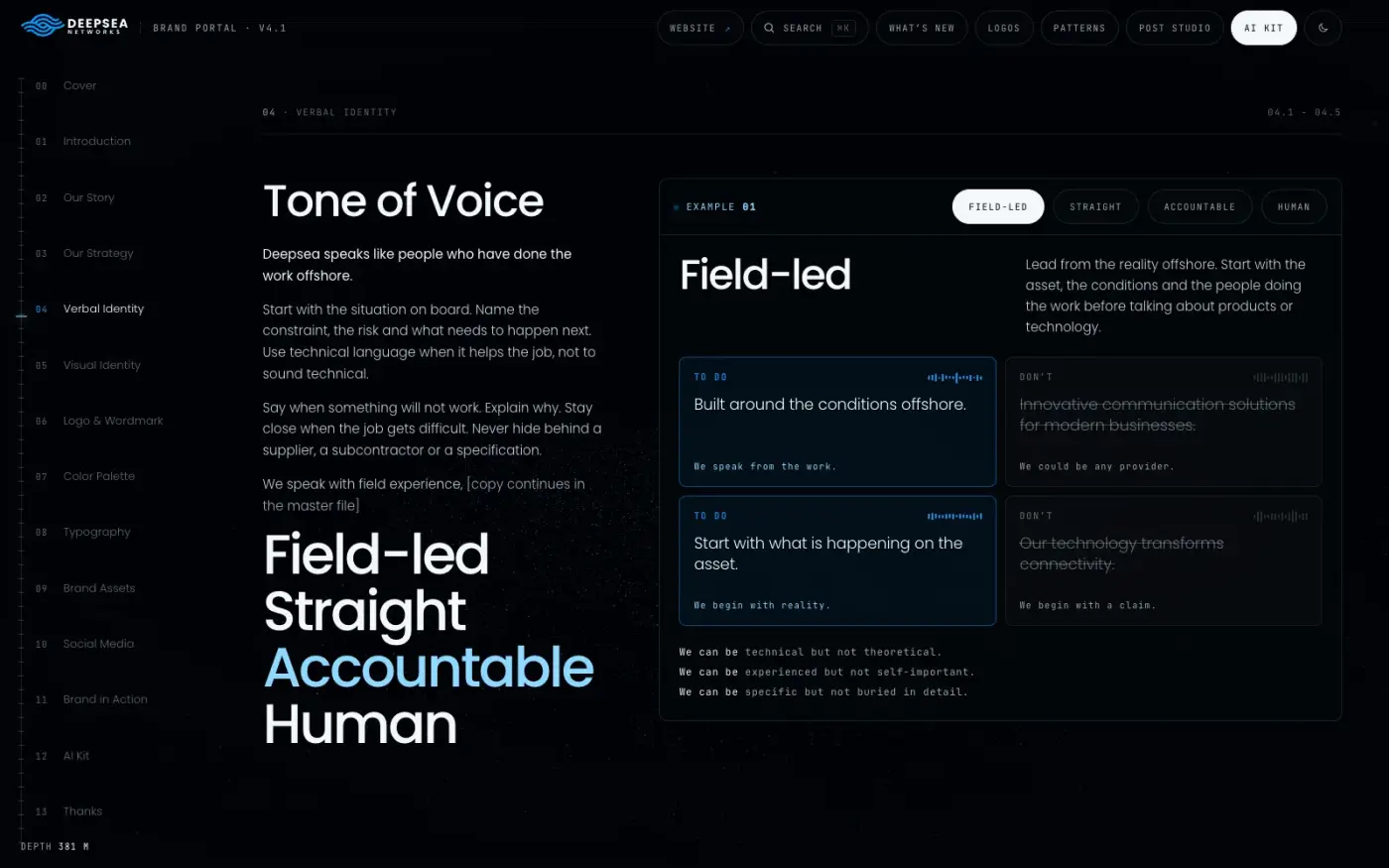
Example:
- Yes: "Your link is live. Here is what changed."
- No: "We are thrilled to announce an exciting update to your experience!"
Step 4: Prompt kits
The five or six jobs your team repeats: sales email, LinkedIn post, case study, proposal intro. Each one is a prompt with blanks to fill, written once, tested on your brand, and pasted by anyone on the team.
Step 5: A check
A short list every draft passes before a person sees it. Are all facts in the register? Is anything promised that should not be? Are the banned words absent? Same list for the AI and for the human reviewer.
Step 6: One live place
All of it in one spot your team can open, next to the logo files and templates. This is what I mean by Brand OS Portal: your brand as a private, interactive, easy-to-use portal your team makes things with, with the same brand loaded into ChatGPT and Claude.
What does it look like in the AI's answer?
A real pair from my test. The prompt: "What uptime does Deepsea guarantee? Write a one-liner for a sales email."
"Deepsea Networks backs our offshore connectivity with a 99.9% uptime guarantee, so your vessels and platforms stay connected when it matters most."
"We do not quote a standard uptime figure: we design a hybrid network around your asset, back it with 24/7 support and agree commitments with you directly."
It added a note that no approved uptime figure exists, so none is stated.
Proof: what happened at Deepsea Networks
On 8 October 2026 I ran a blind test on Deepsea's AI answers. The same AI model (Claude Sonnet) wrote answers to 16 prompts in four setups, and blind AI judges scored shuffled, unlabelled answers. With a one-line prompt, 8 of 16 answers broke a hard rule: an invented fact, a leaked secret, a promise made for headquarters, a claim to be the best. With the written brand system loaded, 0 of 26 did. On six prompts the system was never tuned for, a blind judge scored generic AI 44 out of 100 and the brand system 91.
It is one client and one test, not a controlled study. The full method, the real answers and the limits are in the Deepsea test article. Pierre-Marc Noël, Deepsea's founder and CEO, gave me his OK to publish the result.
Two more things I can point to, from other clients. At MTG, the team made its own posts the day after the reveal. At the team uses a live brand portal every day.
Mistakes I see
- Writing the guidelines as one more PDF. A bigger PDF is still a PDF.
- Putting adjectives where rules should be. "Bold, trustworthy, human" cannot be checked. "Never promise a guarantee" can.
- No owner. Facts go stale the week a price or a customer changes. One person needs the job of updating the register.
- Loading everything into one giant prompt. Keep the facts, the voice and the check as separate short files, so you can update one without touching the rest.
FAQ
What are AI brand guidelines? Brand guidelines written so ChatGPT, Claude and other AI tools can follow them: approved facts, never-promise rules, voice shown in examples, prompt kits and a check before anything ships.
Do I still need a normal brand book? Yes. Designers and printers still need the logo rules, the colours and the type. The AI kit sits next to the book, not instead of it.
Which AI tools do they work with? ChatGPT, Claude and Copilot, the tools your team already uses. The facts and the voice are plain text, so they go into any of them. Claude can also take them as a skill (see how to turn your brand guidelines into a Claude skill).
Can I write them myself? Parts one to three, yes, in an afternoon, if you know your own facts. The test, the prompt kits and keeping them current is where a second pair of eyes helps.
How long does it take with you? 10-14 days on top of a brand you already have, or inside a Brand System or Full Launch package. Fixed price, set before work starts.
One next step
If you want the whole kit built, tested and connected to your team's tools, read about Brand OS Portal.
By Vedran Obradović, Founder & Branding Specialist at Vizura Studio® in Zagreb. 250+ brand projects over 8+ years, most for B2B tech companies. Updated 21 October 2026.
Sources
- Anthropic, Agent Skills overview: https://platform.claude.com/docs/en/agents-and-tools/agent-skills/overview
- Seer Interactive, AI brand accuracy study (27 August 2026): https://www.seerinteractive.com/insights/ai-brand-accuracy-study
- Frontify, Brand guidelines for AI: https://www.frontify.com/en/guide/brand-guidelines-for-ai
- Superside, Brand guidelines in the AI era: https://www.superside.com/blog/brand-guidelines-in-the-ai-era