
 Hrvatski
Tone of voice prompts for ChatGPT and Claude that use rules, not adjectives
A good tone of voice prompt gives the tool rules it can check, real examples and facts, not words like "friendly" or "professional". Below are 8 prompts you can copy, sorted by job, and they work in both ChatGPT and Claude.
I have not put a score on them, because your brand is not my brand. So you also get a short test, to see what works on yours.
Why do most tone of voice prompts fail?
Because they describe a feeling. "Write in a confident, friendly tone" fits nearly every company on earth. So you get text that also fits nearly every company on earth.
A rule works better, because it can be checked. "Sentences under 20 words" is either true or false. "Friendly" is not. You can check rules by eye, and the tool can check them too.
What do I set up before using these?
Each prompt reads from one block of text. Fill it in once and save it. Copy this:
VOICE RULES
Reader: [Job, company type, what they care about.]
Rules:
- Sentences under [20] words.
- Numbers before adjectives.
- Say "you", not "users" or "customers".
- No exclamation marks.
Words to use: [list]
Words to avoid: [list]
Right: [A real line from your best work.]
Wrong: [A line that does not sound like you.]
Facts you may use: [product names, numbers, customers you may name]
Never say: [guarantees, unreleased features, legal claims]Put this in a ChatGPT Project's instructions or in a Claude skill, so you do not paste it each time. If you do not have rules yet, start with my guide to brand voice guidelines.
What are the 8 prompts?
1. Find your rules from your real writing
Here are 5 texts my company likes: [paste].
Here are 3 we do not like: [paste].
List 5 rules that describe the difference.
Each rule must be something a person can check as true or false.
Do not use adjectives like friendly, bold or professional.
Quote one line as proof for each rule.2. Rewrite a draft in your voice
Using my VOICE RULES, rewrite the text below.
Keep every fact. Do not add new facts.
After the rewrite, list each rule and mark it pass or fail.
Text: [paste]3. Write a LinkedIn post
Using my VOICE RULES, write a LinkedIn post about [real news].
Open with the reader's problem or a fact, not with our company name.
Under 120 words. Use facts from my list alone.
If you need a fact I did not give, write [FACT NEEDED] and do not guess.4. Write a sales email
Using my VOICE RULES, write a short email to [job title] at [company type].
They care about [one thing]. Ask one clear question at the end.
Under 90 words. No "I hope this finds you well".
Make no promises beyond my facts list.5. Check a draft for tone
Check this text against my VOICE RULES.
For each problem, show the exact words, the rule it breaks and a fix.
Do not rewrite the whole text.
If it follows all the rules, say so. Do not invent problems.
Text: [paste]6. Catch made-up claims
Read this text. List every fact, number, promise and comparison in it.
Mark each one: on my facts list, or not on my facts list.
Mark anything on my never-say list in capitals.
Do not judge the tone in this step.
Text: [paste]7. Change the channel and keep the voice
Using my VOICE RULES, turn this text into:
1. A LinkedIn post, under 120 words.
2. A website paragraph, under 60 words.
3. A support reply, under 80 words.
Keep the same facts and the same rules. Change the length and purpose, and nothing else.
Text: [paste]8. Make the tool ask before it guesses
Before you write, read my VOICE RULES and my request.
Ask me up to 3 questions if a fact, audience or goal is missing.
Do not write until I answer.
If nothing is missing, write the draft and say that nothing was missing.
Request: [paste]What does a before and after look like?
This example is made up, to show the shape. The company is called Northway, and it sells warehouse software.
| Text | |
|---|---|
| Adjective prompt result | "We are thrilled to offer a powerful new way to transform your warehouse operations." |
| Rule prompt result | "Your team loses time looking for stock. Northway shows where each box is, on any phone." |
| What changed | Reader's problem up front, no hype words, and every claim can be checked against the facts list |
How do I know if a prompt works on my brand?
Run this test in about 20 minutes. Copy it.
PROMPT TEST
Job: ______   Tool: ______   Date: ______

1. Run the prompt 3 times in new chats.
2. Score each answer:
   All facts on my list?         Y / N
   Any never-say item?           Y / N
   Passes my rules, line by line? Y / N
   Would I send it with small fixes? Y / N
3. Give the answers to a colleague, with no labels.
   Can they pick the one that sounds like you?
4. Change one line in the rules. Run it again.Save the prompts that pass in a shared note. A made-up fact means a fail, even if it sounds great. I ran a bigger version of this idea on a real client in my blind test on Deepsea Networks.
Tools change with each model update, so run it again now and then. For the full setup, read how to make ChatGPT use your brand voice and brand guidelines for Claude.
What if my team will not use the prompts?
Prompts live in one person's notes, and that is the weak spot. Someone uses an old one. A new hire never finds it. Nobody checks the result.
Here is how that looks when the check sits next to the work:
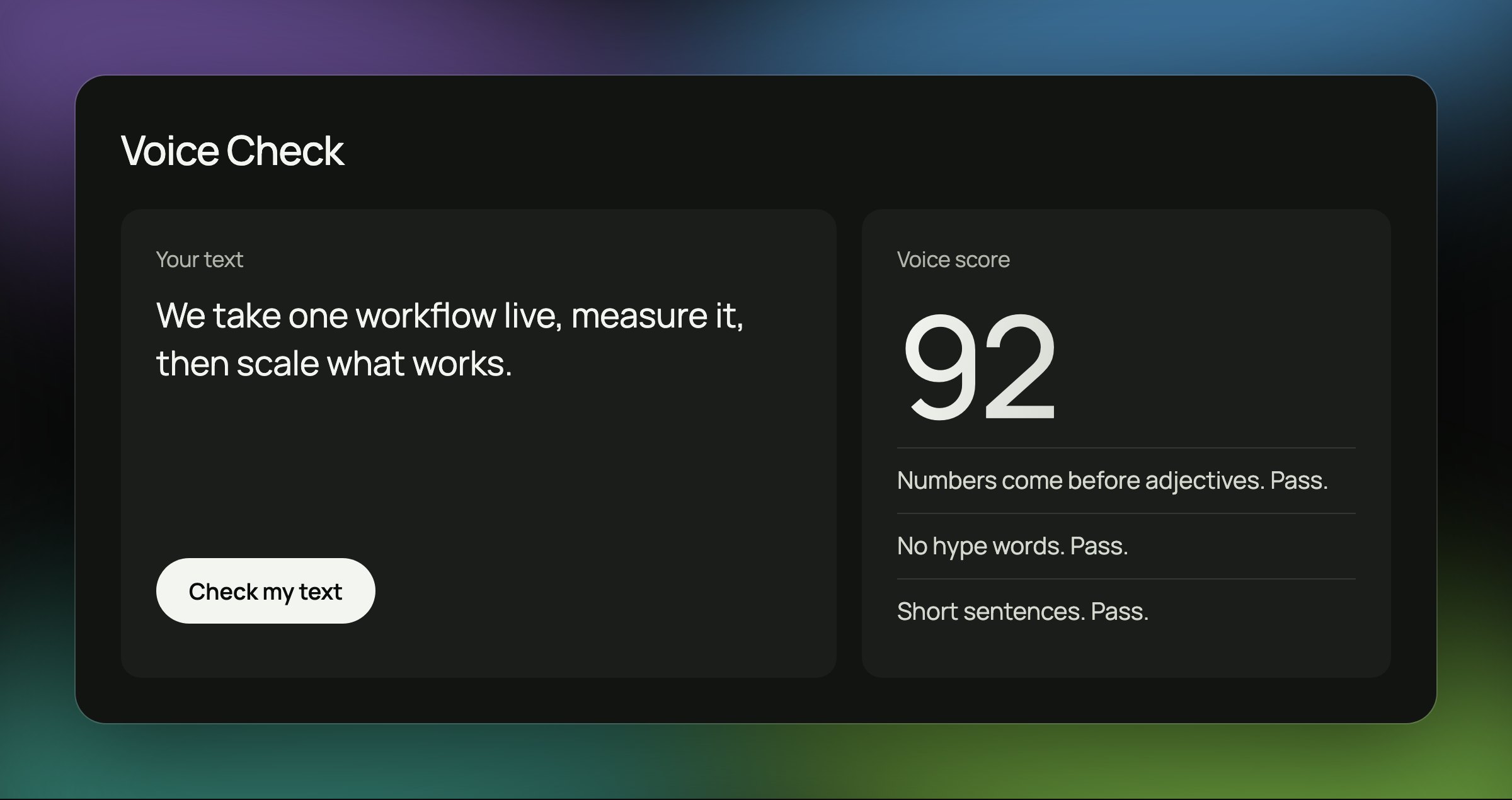
A score is a helper, not a judge. It can catch hype words and long sentences. A person still has to check facts and promises, which is why prompt 6 is on this list.
Brand OS Portal puts your voice rules, AI Kit and Voice Check in one online place, next to the tools that make your posts and slides. So your rules stay in one spot, and the whole team uses them.
Send me your website, and I build 3 real designs with your brand in 48 hours.
FAQ
Do these work in both ChatGPT and Claude? Yes. They are plain text. Models answer differently, so run the test in each tool you use.
Should I use custom GPTs for this? Not for new work. OpenAI plans to retire custom GPTs on Dec 11, 2026. Use a Project or plugin.
How many voice rules should I have? Start with 3 to 5. More rules are harder to follow and harder to check.
Can I ask AI to invent my tone of voice? It can find patterns in your real writing, as in prompt 1. You still decide what to keep, because you know what the company stands for.
Is this tied to OpenAI or Anthropic? No. Claude is a trademark of Anthropic. Vizura Studio is an independent studio, not affiliated with Anthropic or OpenAI.
One fixed price to build it. A small monthly Care fee keeps it running.
Want this for your brand?
15 minutes. No sales talk. You leave knowing what to do next.